You want a business line on your cell without your home address ending up in every reverse-lookup tool on the internet. Reasonable goal — and mostly achievable, but only if you understand which pieces of your info are required, which are optional, and which leak by default.
Here's what actually shows up publicly when you provision a VoIP number, what your provider is legally required to collect, and the concrete steps to keep your personal details out of CNAM, 411, and the data broker pipeline.
What your provider must collect (and why)
Every legitimate US VoIP provider runs Know Your Customer (KYC) checks. This isn't a sales tactic — the FCC has pushed carriers toward financial-industry-style identity verification to cut down on robocall fraud and spoofing. Add to that 10DLC registration for SMS, E911 address requirements for voice, and the fact that the IRS and most banks want a real entity behind the account.
At minimum, expect to provide:
- Legal name (yours or your business's)
- A verifiable address — this becomes your E911 registered location
- A billing method tied to a real identity
- For SMS at any volume, a registered 10DLC brand (EIN, business address, website)
The provider has to know who you are. That's not the privacy problem. The privacy problem is what happens to that data afterward.
What's actually public vs. what isn't
There's a wide gap between "the carrier has it" and "anyone can Google it." Three different layers are at play:
CPNI protects the carrier-held data
Customer Proprietary Network Information rules under FCC Section 222 prohibit carriers from disclosing your account details — name on file, billing address, call records — outside of narrow exceptions (court order, your written consent, internal use). Your VoIP provider can't just hand your address to a random caller. They can't even confirm you're a customer without authentication.
CNAM is the public-facing label
Caller ID Name (CNAM) is the 15-character text that shows up on the receiving end when you place a call. This is the field most people accidentally leak their full name into. Outbound CNAM is set by your provider and pushed to a CNAM database that terminating carriers query. Inbound CNAM is whatever the dipping carrier finds in those databases for your number.
You control what your CNAM says. Set it to your business name, an LLC name, or a generic descriptor — never your personal name unless you want it on every recipient's screen.
411 / directory listings are opt-in (mostly)
Traditional 411 listings come from carrier-submitted directory data. Most VoIP providers don't auto-publish to 411 — but some do, and some resell DIDs from underlying carriers that may. Read the provider's privacy policy and ask explicitly whether your number gets published to directory assistance.
Data brokers are the real leak
This is the part nobody can fully solve. Brokers scrape, buy, and correlate data from public records, app SDKs, loyalty programs, and anywhere else they can get it. The moment you use your business number to sign up for anything that resells data, the linkage starts.
Concrete steps to keep your name off lookups
None of these are silver bullets, but stacked together they cover the realistic threat model: someone Googling your number or running it through a reverse-lookup tool.
1. Register a business entity first
Form an LLC (or use an existing one) and use it as the account holder on the VoIP service. Your provider's KYC is satisfied by the entity. Many states let you use a registered agent address instead of your home address on the public filing — pay for one.
2. Use a non-residential address for the account
A registered agent address, a coworking suite, or a UPS Store mailbox with a real street address works for billing. For E911, the address must be where you'll physically be when you make a call — so use your real location there, but understand E911 data is only released to PSAPs during a 911 call, not to the public.
3. Set your outbound CNAM deliberately
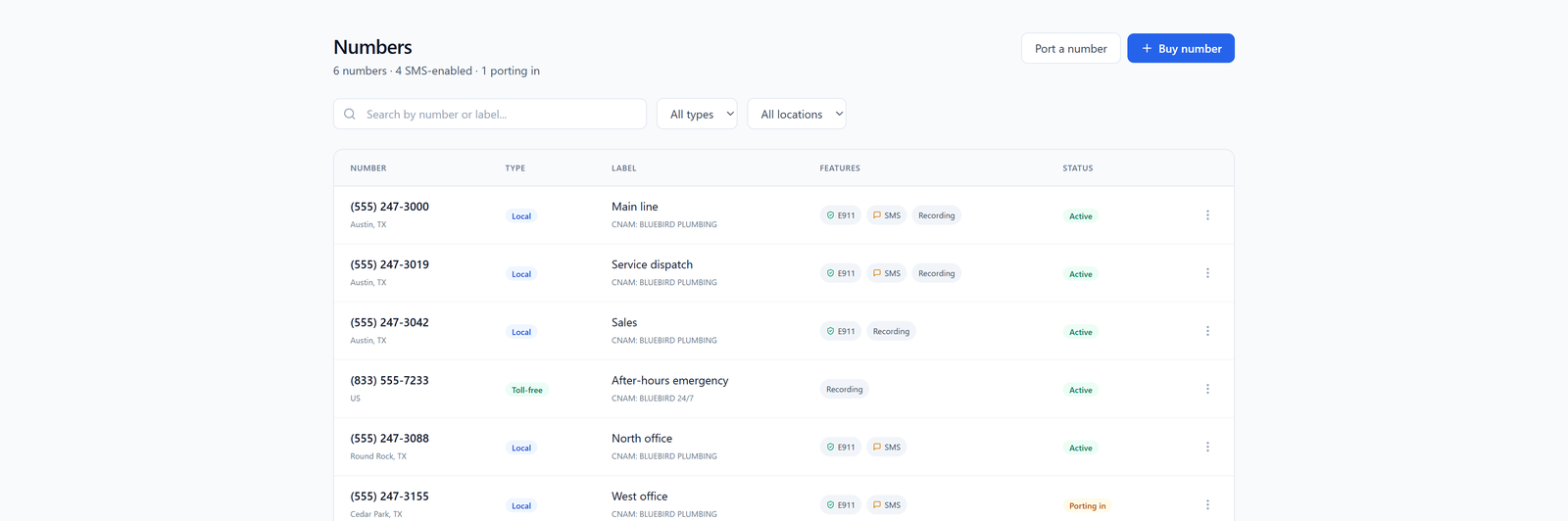
When you provision the number, set the outbound CNAM to your business name. Don't leave it blank (some carriers fall back to registrant data) and don't put your personal name. If you don't know how to set it, ask the provider — it's usually a per-DID setting in the portal.
4. Opt out of directory listings
Ask the provider in writing to suppress 411 / directory assistance publication for the DID. Most will confirm in a ticket reply. If you're porting an existing number, check that the losing carrier wasn't already publishing it.
5. Pick a provider whose privacy policy you've actually read
Look for explicit statements that they don't sell customer data to brokers or advertisers. Free consumer apps fund themselves somehow — usually that's you. A paid business VoIP account with a clear privacy policy is a different product.
What about 10DLC brand registration?
If you plan to send SMS from the number, 10DLC brand registration is mandatory and it requires your EIN, legal business name, and business address. That data goes to The Campaign Registry (TCR) and the carriers — not to the public. TCR data isn't a consumer-facing directory.
The practical move: register the brand under your LLC with the registered agent address. Your EIN is tied to the business, not your SSN, so the personal linkage stays minimal. We cover the mechanics in our business SMS 2026 guide and the carrier approval requirements walkthrough.
What you can't fully prevent
Being honest: if you use the number every day, signals will accumulate somewhere. You'll hand it to a vendor that gets breached. You'll sign up for a service whose terms permit resale. Someone you call will save it under your name in their contacts and that contact list will eventually sync into a people-search product.
The goal isn't invisibility — it's making the casual lookup return your business name and a business address, not your home. That's an achievable bar. Total anonymity on a number you use commercially is not.
If you're stacking multiple lines or numbers for different functions, buying DIDs in volume under one business account is cleaner than spreading personal accounts across providers — fewer KYC footprints, one privacy policy to vet.
What to do next
- Form or identify the business entity that will hold the account.
- Get a registered agent or commercial mail address for billing.
- Choose a provider, read their privacy policy, and ask in a ticket: (a) do you publish to 411, (b) can I set my own CNAM, (c) do you sell data to brokers.
- Provision the number with business-name CNAM from day one.
- Use the number consistently for business only — mixing it with personal signups undoes the work.
Do those five things and a stranger Googling your number gets your LLC name and a registered agent address. That's the practical win.