Every missed call is a customer who called your competitor next. You know it. You've heard the voicemail from Tuesday at 2pm asking for a quote, and by the time you called back Wednesday morning they'd already booked someone else.
A full-time receptionist runs $35,000+ a year with taxes. You don't need one yet. You need the phone to stop dropping revenue on the floor. Here's how to do that for less than your monthly coffee budget.
Stop thinking about "the office phone"
There is no office phone anymore. Or rather, there shouldn't be. The phone number on your business card should be a smart routing rule, not a physical desk phone that rings into an empty room at 4:47pm on a Friday.
Modern business phone service lets one number ring anywhere you want it to — your cell, your tech's cell, three cells at once, a voicemail box that texts you, whatever. The number is software. Once you accept that, everything else gets cheaper.
If you're still on a landline or a copper line from the local phone company, that's your first move. A modern hosted phone system starts around $20/user/month and replaces the wall jack entirely.
Fix #1: Ring your cell (and your team's cells)
The fastest win. Your business number rings, and instead of dying in an empty office, it rings your cell phone. If you don't pick up in 15 seconds, it rings your lead tech. If they don't pick up, it rings the shop manager.
This is called a ring group — a fancy term for "ring several phones at once or one after another." You set the order, you set how long each phone rings, and you set what happens if nobody answers (usually: voicemail that emails and texts you the message).
A plumber I know set this up on a Tuesday and booked two extra jobs by Friday from calls that used to hit voicemail. Nothing else changed.
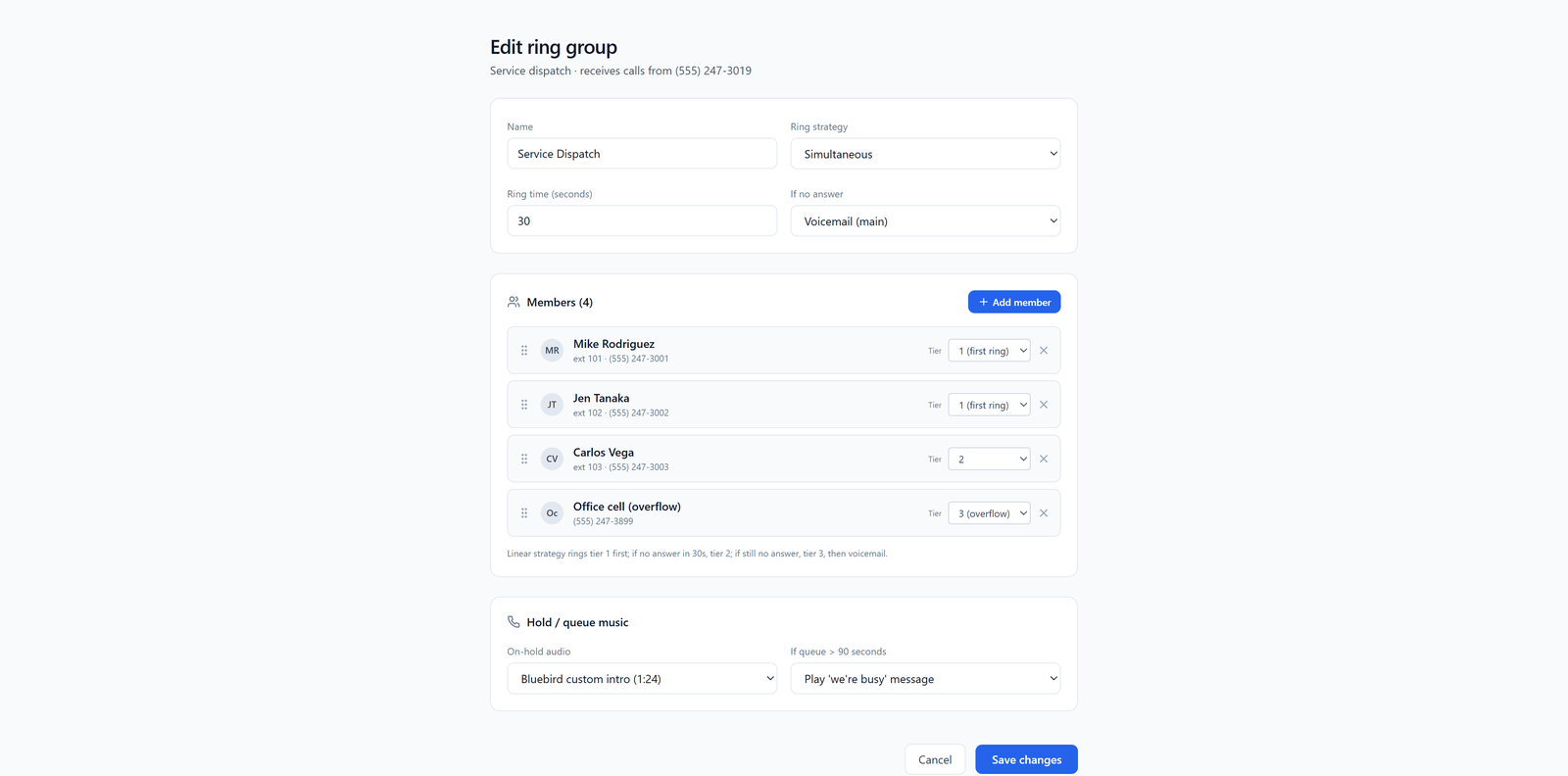
One important note: your team can answer these calls on their personal cell without giving out their personal number. The customer sees your business number on caller ID. Your tech's cell number stays private. There's more on how the business number rings on your cell if you want the mechanics.
Fix #2: An auto-attendant that isn't annoying
"Press 1 for sales, press 2 for service." You've heard it a thousand times. It works because it triages the call before a human picks up.
You don't need 8 options. You need 2 or 3:
- Press 1 — existing customer, service issue (rings your service tech's cell)
- Press 2 — new quote (rings your cell, then falls back to voicemail-to-text)
- Press 0 or stay on the line — rings everyone
That's it. A greeting, three options, and a fallback. It takes 15 minutes to set up. It runs 24/7. It never calls in sick.
Keep the greeting short
"Thanks for calling Miller Plumbing. For a current job, press 1. For a new quote, press 2. Or stay on the line." Done. Nobody wants to hear your mission statement.
Fix #3: Voicemail that actually reaches you
A voicemail sitting in a mailbox nobody checks is worse than no voicemail at all — you think you're covered, but you're not.
Set up voicemail-to-text and voicemail-to-email. When someone leaves a message, you get a text with a written transcript and an email with the audio file. You read it at a red light. You call back in 4 minutes instead of 4 hours.
The transcript isn't always perfect — names get mangled, addresses get creative — but you'll know it was Dave from the Oak Street job asking about a leaking valve, and that's enough to call back informed.
Fix #4: Missed-call auto-text
This is the one most owners haven't heard of and it's the biggest lever. When someone calls and you can't pick up, they get an automatic text within seconds:
"Hey, this is Mike at Miller Plumbing — sorry I missed you. Text me back here with what you need and I'll get right back to you."
Half of them will text back. You're now having a conversation instead of playing voicemail tag. And texts are easier to answer between jobs than calls. There's a full breakdown in missed-call auto-text for leads if you want the copy templates.
Fix #5: After-hours routing
After 6pm your calls shouldn't ring your cell forever. They should:
- Play a short after-hours greeting ("We're closed but leave a message or text this number")
- Offer an emergency option that rings the on-call person
- Send everything else to voicemail-to-text
Weekends and holidays get their own schedule. Set it once. It runs itself. See same-minute response for missed calls after hours for how to actually beat competitors overnight.
What this costs, honestly
Here's real math for a 5-person plumbing shop:
- Business phone service: $100/month (5 users at $20)
- One business number with texting: $2–5/month
- Auto-attendant, ring groups, voicemail-to-text: included
- Missed-call auto-text: included or a few cents per text
Call it $110/month. That's $1,320 a year. A receptionist is $35,000+.
If this setup rescues one $400 job a month, it pays for itself three times over. Most shops I've talked to rescue more than that in the first two weeks.
What to do next
Stop reading. Do this today:
- Pick a service that supports ring groups, auto-attendant, and voicemail-to-text out of the box. Check the pricing page so you know what you're signing up for.
- Port your existing number over so customers don't need to learn a new one.
- Set up a 2-option auto-attendant and a ring group that hits your cell first, then a backup.
- Turn on voicemail-to-text and missed-call auto-reply.
- Call your own number from a different phone and test it end-to-end. Fix what's clunky.
You can do all of it in an afternoon. You do not need a receptionist yet. You need your phone to stop leaking money.