If you run a service business, the calls that come in after 6pm are the ones that hurt most. Someone's furnace is out, their drain is backed up, their stylist cancelled on them — and if your line rings out, they just dial the next shop on Google. That's revenue walking out the door while you're eating dinner.
The good news: you don't have to answer every call yourself, and you don't have to pay a stranger $300 a month to half-answer them for you. There are four setups that actually work for a small shop. Here's how to pick.
Option 1: Forward the business line to your cell
This is the simplest thing you can do tonight. Your business number rings on your personal phone after hours. You pick up when you can, same as any other call.
When it makes sense: Solo operator or you + one partner. You're already the person who'd take the call anyway. You just don't want customers calling your personal cell directly and texting you at 11pm about scheduling.
Cost: Essentially free if your phone service already supports it. Most modern business lines do. If you're on an older setup where this is a hassle, a business number that rings on your cell is a 10-minute switch.
Downside: You're on call. If you want real off hours, this isn't it.
Option 2: A shared ring group so your team can pick up from their phones
This is the one most small shops don't know exists, and it's the biggest upgrade for the money. A ring group means your one business number rings several phones at once — yours, your lead tech's, your dispatcher's — and whoever grabs it first, gets it. The phones can be real desk phones, cell phones with an app, or both.
So at 7pm, your business line rings. It buzzes on your cell, your service manager's cell, and maybe your night tech's cell. First person free answers. The others stop ringing. Customer gets a human. You didn't hire anyone.
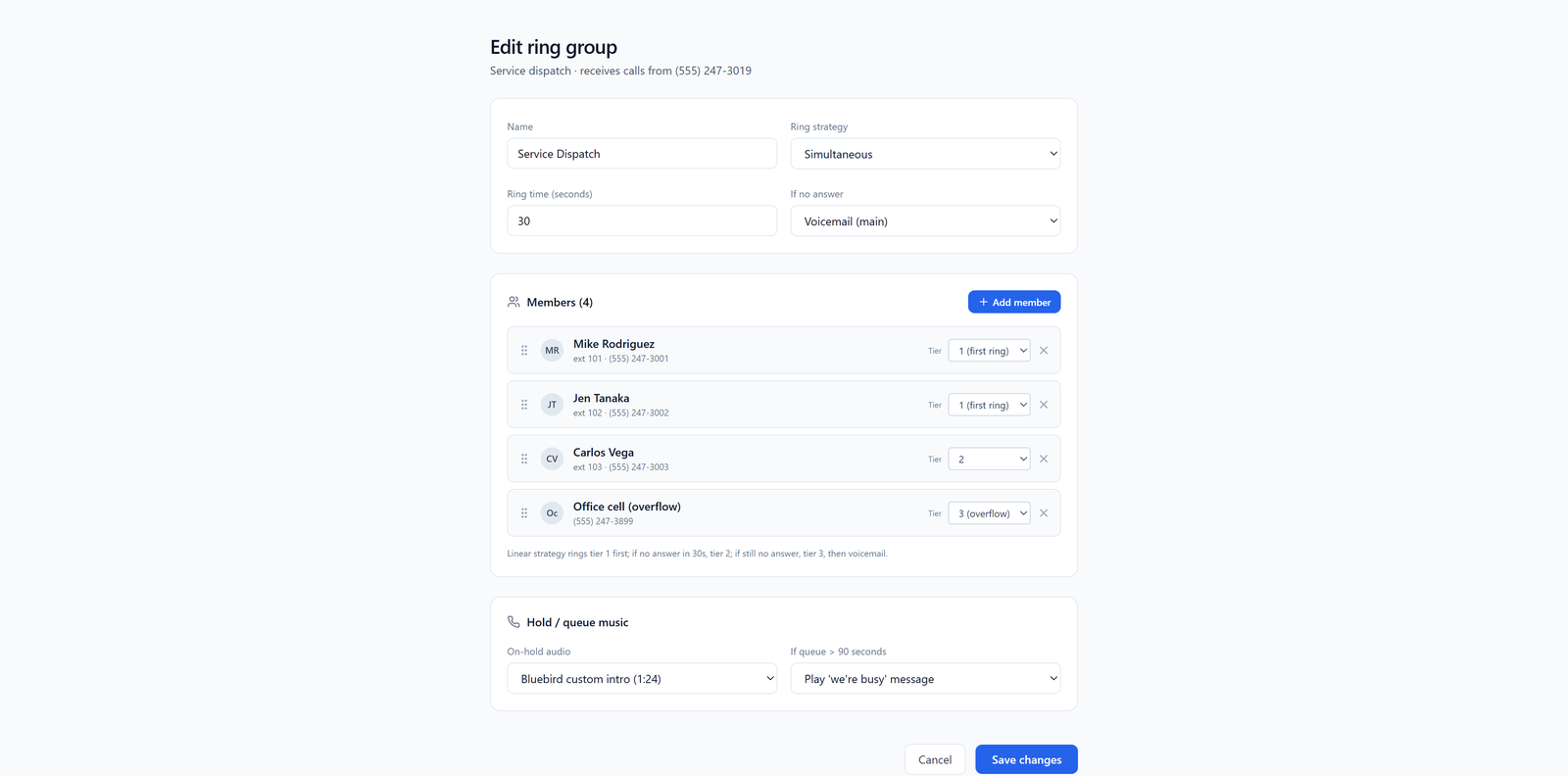
When it makes sense: You have 2–10 employees and at least one of them is willing to take an after-hours call for a small bonus or on a rotation. Way cheaper than a full on-call salary.
Cost: The phone service itself, plus whatever you pay the employee for being on call. The ring group feature itself is included in a normal business phone system — you shouldn't be paying extra per group.
Setup tip: Rotate who's on the ring group by night of the week. Nobody burns out, everyone gets a shot at the overtime, and your line is always covered.
Option 3: Smart voicemail that texts you (and texts the caller back)
If you really can't take the call, don't let it die in a voicemail box nobody checks. Two things need to happen the moment someone hangs up:
- You get a text with the caller's number and ideally a transcription of what they said.
- The caller gets a text back from your business number — automatically — saying "Thanks for calling, we got your message, we'll call you first thing in the morning. Reply here if it's an emergency."
That second one is the magic. Most people don't leave voicemails because they assume it's a black hole. If their phone buzzes 30 seconds later with a real reply, they stop dialing your competitors. We've written more about the missed-call auto-text pattern and why same-minute response matters so much after hours.
When it makes sense: You've decided after-hours is truly off, but you want to save the lead for tomorrow. Also great as a backup layer on top of options 1 or 2 — for the calls that still slip through.
Cost: Should be included in a decent business phone setup. If you're being charged extra per auto-reply, you're on the wrong plan.
Option 4: The callback-promise greeting
This is the lowest-tech option and it still works. Record a greeting that sounds like a human wrote it, not a robot:
"Hi, you've reached Miller Plumbing. We're closed for the night but we check messages at 7am sharp and we will call you back before 8. If this is a true emergency — water actively flooding — press 1 and it'll ring the on-call tech directly."
That does three things. It sets a specific expectation ("before 8"), it gives the customer a reason to actually leave a message, and it reserves the live-ring for real emergencies so your tech isn't woken up for a slow drip.
When it makes sense: You're a trade where emergencies are real (plumbing, HVAC, locksmith, electrical, towing). The press-1 option gives you a filter.
Why the answering service didn't pay off
Quick note on this since a lot of owners try it first and get burned. Paid answering services charge per minute or per call, and the people answering don't know your business. They can take a message. That's about it. They can't quote, they can't schedule, they can't tell a real emergency from a confused caller. For most small shops, you're paying $200–$500/month to get messages you could have gotten from a voicemail-to-text for $0. For a side-by-side on how a 3–20 person shop can realistically cover calls without hiring a receptionist, it's worth comparing the tradeoffs before you sign anything.
If you're going to spend that money, spend it on an on-call bonus for an actual employee who knows the work. Pair it with a ring group and you'll convert way more of those calls.
What to do next
Mix and match. The setup that works for most small service businesses:
- Primary: Ring group that hits 2–3 cell phones (you + whoever's on call).
- Backup: Auto-text reply the second a call is missed, so the caller knows you got it.
- Fallback: A clear voicemail greeting with a real callback promise and a press-1 emergency option.
Start with the auto-text — it's the fastest win and it stops the "they called the next guy" problem overnight. Then layer in the ring group when you've got a teammate ready to share the load. If you want to see what missed calls are actually costing you before you change anything, audit a month of missed calls first. The number usually surprises people.