A customer calls while you're elbow-deep under a sink. Or driving between jobs. Or it's 7pm and you're finally home. That call is money — and if it goes nowhere, they're dialing the next shop on the list.
Here's the honest rundown of what small shops actually do, when each one makes sense, and what it costs.
Option 1: Forward the call to a teammate's cell
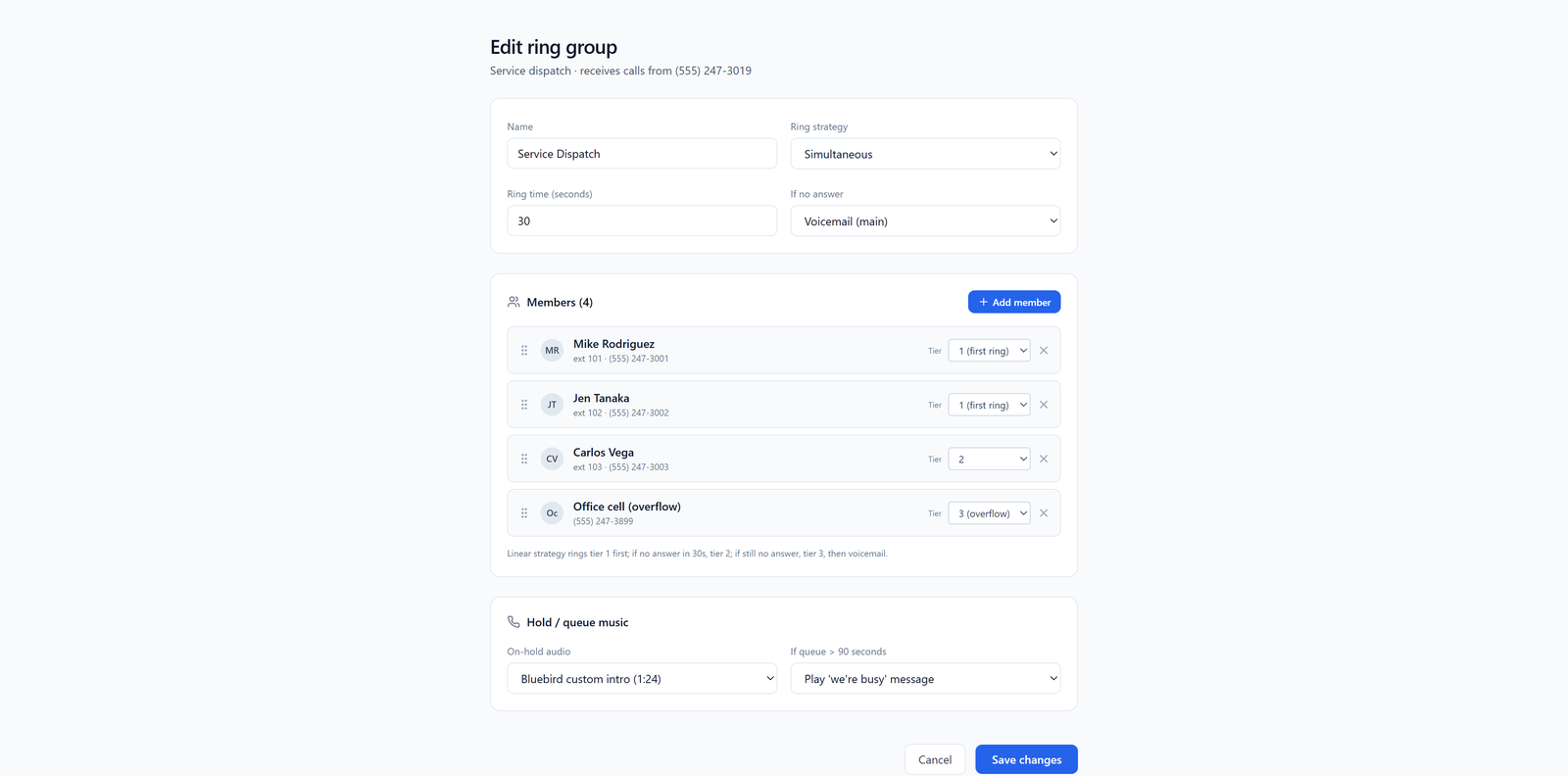
Simplest fix. Your business number rings, and if you don't pick up in 20 seconds, it rings somebody else's phone. Then somebody else's after that. Or all of them at once.
This is called a ring group — a short way of saying "ring more than one phone." You set an order (you first, then your lead tech, then your spouse who handles the books) or you set it to blast everyone at once and whoever grabs it first wins.
When it fits: You've got 2–5 people who are willing to answer a work call on their personal phone. A plumbing shop with a couple of techs. A salon with a receptionist and two stylists. A small agency where any account manager can take a lead.
Rough cost: Usually baked into a business phone plan. Figure $15–$30 per user per month on most hosted systems. See our pricing page for a concrete number.
Watch out for: Employees burning out on after-hours calls. Set a schedule — nights and weekends go somewhere else (see option 4).
Option 2: Voicemail that actually gets read
Plain voicemail is where leads go to die. Nobody dials in and punches a PIN to listen to messages anymore.
What works: voicemail-to-text and voicemail-to-email. The caller leaves a message, the system transcribes it, and you get the text and the audio file in your inbox or as a text message within a minute. You read it at a stoplight. You call back when you're free.
When it fits: Solo operators and 2–3 person shops. Anyone whose job keeps their hands busy for stretches of time.
Rough cost: Standard feature on any modern business phone system. No extra charge in most cases.
Watch out for: Transcription isn't perfect with background noise or heavy accents. Always get the audio too.
Option 3: Auto-text the missed caller
This one punches above its weight. The moment a call goes unanswered, the system fires off a text to the caller: "Hey, this is Mike at Mike's Plumbing. Can't grab the phone right now — text me here and I'll get back to you within the hour."
A huge chunk of people will text back. And now you've got a written thread you can answer between jobs instead of playing phone tag. We wrote more about this in missed call auto-text for leads and same-minute response for after-hours calls.
When it fits: Any service business. Especially trades, home services, and anything where you're on-site a lot.
Rough cost: Pennies per text. The feature itself is usually included; you pay for the texts you send.
Watch out for: You need to be registered to send business texts to US customers. Not hard, but it takes a week or two to get approved.
Option 4: After-hours greeting and routing
Set your phone to behave differently after 6pm and on weekends. A short greeting: "Thanks for calling. We're closed, but leave a message or press 1 for emergencies." Emergencies ring your on-call tech's cell. Everything else drops into voicemail and gets texted to you first thing in the morning.
When it fits: Any shop with real business hours. Especially useful if you want to protect your evenings but still catch true emergencies (burst pipes, lockouts, broken AC in July).
Rough cost: Included in most business phone plans. Zero extra.
Watch out for: Train your greeting to set expectations. If you say "we'll call back within an hour" at 10pm, you'd better do it.
Option 5: A live answering service
Real humans answer in your company's name, take a message, book an appointment, or patch urgent calls through to you. Think of them as a receptionist you share with a hundred other businesses.
When it fits: You're drowning in calls, you're closing enough deals that one missed call hurts, or your trade is one where callers won't leave voicemails (medical, legal, high-ticket home services). Also good when you need bilingual coverage.
Rough cost: This is where it gets expensive. $1–$2 per minute, or $300–$1,500/month depending on volume. Do the math on how many deals you need to close to justify it.
Watch out for: Scripts matter. A bad answering service is worse than voicemail — nothing kills a lead faster than a bored stranger who can't answer basic questions about your business.
Option 6: Shared text inbox
If half your customers would rather text than call, give them a number they can text. Then let your whole team see and reply to those messages from one inbox — just like a shared email account, but for text messages.
Now when a customer texts "are you open Saturday?", whoever's free picks it up. Nothing falls through the cracks because everyone can see the thread.
When it fits: Salons, repair shops, agencies, anyone whose customers skew younger or just prefer texting. Pairs great with option 3. More on this in running a service business on SMS without losing the thread.
Rough cost: $15–$30 per user per month, often bundled with voice. Check out business texting.
What this actually looks like for a 5-person plumbing shop
Here's a realistic stack:
- Business line rings the office first, then rolls to the two techs on call (ring group).
- Any missed call gets an auto-text: "Can't talk — text here and we'll respond within the hour."
- After 6pm, calls skip the office and go straight to on-call tech. Non-emergencies go to voicemail-to-text.
- Owner reads voicemail transcripts over morning coffee and divvies up callbacks.
Total cost: maybe $100–$150/month for the whole shop. One saved job pays for the year.
What to do next
Start with the cheapest, highest-leverage move: turn on voicemail-to-text and set up auto-reply texts for missed calls. That alone will recover more leads than any other single change.
Then look at your call pattern for a week. Are you missing more during work hours (ring group problem) or after hours (greeting + on-call problem)? Fix the bigger leak first.
If you want the whole thing in one place — business phone with ring groups, voicemail-to-text, and shared texting — that's what we built Text N Dial for.