Here's a number most owners can't tell you off the top of their head: how many new-customer calls went to voicemail last week. Not returned voicemails. Not callbacks. Calls that rang, hit voicemail, and then the person hung up and called your competitor.
That number is almost always bigger than owners think. And it's almost always the quietest revenue leak in the business.
Why missed calls hurt more than you think
A returning customer will leave a voicemail. They know you. They'll wait.
A new customer won't. They're shopping. They have your competitor's number in the next tab. If your phone rings four times and dumps to voicemail, they're gone — and you'll never know they called.
Think about your own behavior. When you call a plumber at 7pm and get voicemail, do you leave a message and wait? Or do you call the next one on Google?
That's what's happening to your business at lunch, after 5pm, on Saturdays, and any time your front desk is on another call.
Step 1: Actually measure it
You can't fix what you don't see. Before you change anything, get a baseline for a week or two. For a step-by-step walkthrough of pulling 30 days of call data and spotting the patterns, see how to audit your missed calls before they cost you.
What you want to know:
- How many calls came in total
- How many got answered by a human
- How many hit voicemail
- How many hung up without leaving a message
- What times of day the misses cluster
Most modern business phone services show this in a basic dashboard. If yours doesn't, that's a problem on its own. Our phone system shows answered, missed, and abandoned calls per number and per hour, so you can spot the pattern in about ten minutes.
Look for the cluster. For a dental office it's usually 12-1pm and after 5pm. For a plumber it's evenings and Saturdays. For a salon it's the busiest service hours when staff have their hands full.
Step 2: Put a real dollar number on it
This is the part owners skip, and it's the part that justifies fixing the problem.
Take your missed-call number for a week. Cut it in half — assume only half were actual new prospects (the rest are wrong numbers, spam, existing customers who'll call back). Multiply that by your typical close rate on a new inquiry. Multiply that by what a new customer is worth to you.
Quick example. A small clinic misses 40 calls a week. Say 20 are real new patients. They close maybe 1 in 3 over the phone — so 6-7 new patients a week walking to a competitor. If a new patient is worth $400 to you over their first year, that's around $2,500 a week leaking out the back door.
Do your own math with your real numbers. Even if you're conservative, the answer is rarely small.
Step 3: Stop the bleeding at lunch and after hours
You don't need to hire a receptionist to fix most of this. You need calls to land somewhere useful when your front desk can't pick up.
A few setups that work, in order of cost:
Ring the owner's cell after two rings. If the front desk doesn't pick up by the second ring, the call rolls to your cell, or your shop manager's cell, or both at the same time. You're not going to answer every call, but you'll catch the urgent new-customer ones at lunch. We wrote about exactly this in making your business number ring on your cell. If you're still using your personal cell as the business line, here's how to add a dedicated business number without carrying a second phone.
Group ringing. Two or three staff cells ring at the same time. First one to grab it gets the call. Good for a 5-person shop where someone is usually free. If you have a bigger team, here's how to route one number to as many as 50 cell phones at once.
A real after-hours greeting with options. Not "leave a message." Something like: "Press 1 for an emergency, press 2 to request an appointment by text, press 3 to leave a message." The text option alone catches a huge chunk of new leads who don't want to talk to voicemail. Just be careful with the wording — here's how to phrase after-hours auto-replies so customers don't start expecting 9pm answers. For the full playbook on stacking auto-attendants, cell forwarding, and voicemail-to-text so no call slips through, see how to cover every call without hiring a receptionist.
Auto-text on miss. When a call goes unanswered, the caller gets a text within seconds: "Sorry we missed you — reply here and we'll get right back to you." This single change recovers a lot of would-be lost customers. More on this in auto-text on missed calls and same-minute response after hours.
Step 4: Route smarter during business hours
Most in-hours misses happen because one person is already on a call and the second line just rings forever.
Fix that with a ring group — a fancy way of saying "ring multiple phones at once." Front desk first, then roll to a back office line or a manager's cell after 15 seconds. The caller doesn't know or care that the front desk was busy. They just got answered.
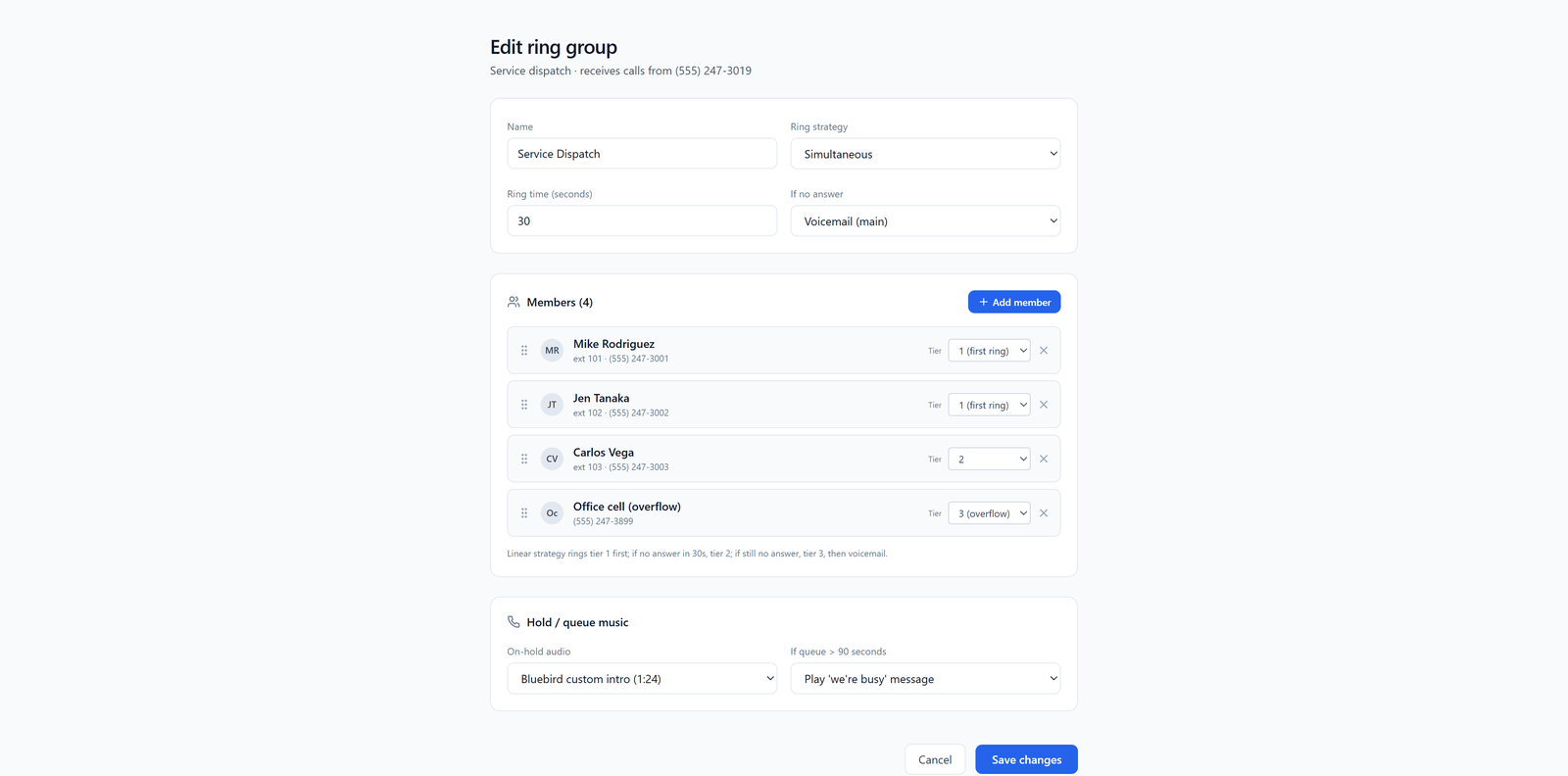
A few practical rules of thumb:
- Don't let any call ring longer than 20-25 seconds before it moves to the next destination. People hang up.
- Always have a final destination that isn't a dead-end voicemail. A cell, a shared inbox, an auto-text — something.
- Test it yourself once a week. Call your own business number at 12:30pm and at 8pm. See what happens.
Step 5: Re-measure after two weeks
The whole point of measuring first is so you can prove the fix worked. After you've made the changes, look at the same numbers two weeks later.
You want to see:
- Missed call count down
- Abandoned calls (hung up without voicemail) way down
- New customer inquiries up — track this from your booking system or just by asking new customers how they reached you
If the numbers didn't move, something in the routing is broken. Call your own number from a phone that isn't yours and walk through every path.
A note on what not to do
Don't try to fix this by guilt-tripping your front desk. They're already busy. The problem isn't them — it's that one person can't physically answer two calls at once, and nobody can answer calls during lunch.
Don't bury people in menus either. A four-level phone tree to "better organize" calls usually makes the missed-call problem worse, not better. Keep it simple. One greeting, one or two options, real humans or real texts at the end.
What to do next
This week, do three things:
- Pull your call logs for the last 14 days and count answered vs. missed vs. abandoned. Note the times.
- Pick the worst time block and set up one fix — usually a roll-to-cell or an auto-text on miss.
- Put a reminder on your calendar for two weeks out to check the numbers again.
That's it. You don't need a new hire, a new phone system overhaul, or an answering service. You need to see the leak, plug the biggest hole, and check that it stayed plugged. The dollar return on two hours of setup is usually embarrassing in a good way.